

Vocaloid Collection is held twice a year and is the biggest submission festival for Vocaloid producers, a major event that could be considered a national tournament.
This is my third time participating.
The original song division has two categories: Rookie and Top 100, and it's been over two years since my first Nico Nico submission, so I once again competed in the Top 100.
Title: "Suguilty"
I was trying to make an opera, but I ended up with a song that sounds more like enka, like something you'd hear about like "Abarenbo Shogun" or "Kitajima Saburo."
As with last time, I ended up out of the running.

Numbers immediately after the end of the last Vocaloid Collection.

Numbers immediately after the end of this one.
The number of plays, comments, likes, and favorites all exceeded the previous number.
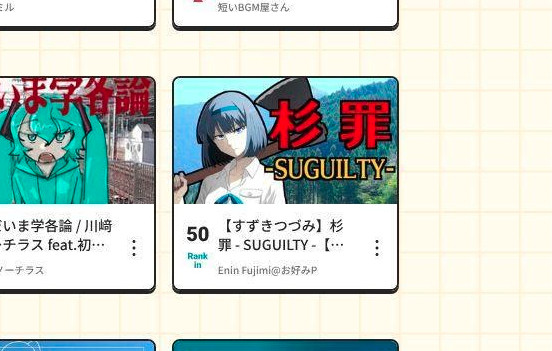
Also, someone was saving screenshots of the rankings every hour, and when I checked, I discovered that my song had temporarily risen to 50th place twice.
To make it to the final round, I need to stay ranked, but since I didn't even come close last time, this can be considered a major step forward and a success.
As with last time, I focused on Nico Nico advertising and social media marketing during the period.
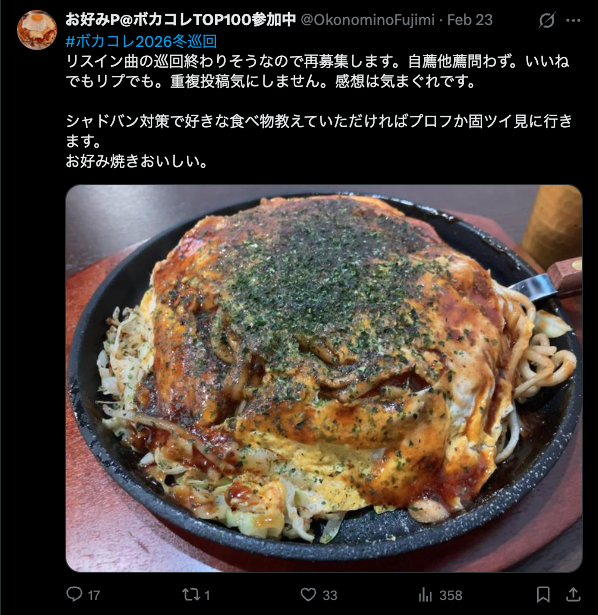
During the Vocaloid Collection, there are many people like this who are soliciting songs from other participants, both self-nominated and recommended by others, and I pushed my song over and over to these people.
Whether I get a response honestly depends on the person, and there's a risk of being shadowbanned if I post too many times, but quite a few people listened to my song, liked it, commented on it, and added it to their favorites.
There may have been some who did this out of obligation, but since they are all egocentric, I'll say that they were all captivated by my work and genuinely liked, commented, and added to their favorites.
Honestly, if I hadn't made this effort to deliver my work, I probably wouldn't have gotten even half the number of views and likes.
Of course, it would be ideal if you could compete purely on the quality of your work, but the reality is not so sweet.
Many producers were desperate to deliver their best works to listeners.
They were digging their own hole-in-the-wall self-nominations and competing for listeners' ears.
Even people who regularly rank high in the charts are doing this, so it's not hard to imagine that if an unknown producer like me didn't do anything, I would lose listeners and end up being buried.
I put my heart and soul into my songs, so I want as many people as possible to hear them.
I'll do whatever I can to make that happen.
While I'm promoting them, I also don't forget to analyze the work of those who applied and use it as reference for future songs and music videos.
As I came into contact with various works, ideas for my next piece began to form.
Input is important after all.
If there's one thing I regret this time, it's that I posted it quite close to the deadline.
I had completely forgotten what I learned last time: that I should have scheduled the post a month in advance so that older posts would be displayed first.
And the other day I had a problem with Wondershare and had to quickly change my video editing software to Final Cut Pro, which also contributed to the delay in making the MV.
Honestly, I should have done it after Vocaloid Collection.
Humans are foolish.
The next Vocaloid Collection is apparently going to be held in late August, so this time I'll make sure to start working with plenty of time to post in late July.
This post has gotten long, so I'll talk about the behind-the-scenes stories of my work another time if I feel like it.
And that's all!
During my lunch break at work, I was casually checking my inbox when I found a payment notification from PayPal for something I didn't recognize.
The amount was just under 2000 yen, and the invoice was from Wondershare.
It was from the maker of Filmora, the video editing software I had purchased last month.
???
Filmora offers two ways to purchase it: as a one-time purchase or a subscription, but I chose the one-time purchase, so there was no way I would receive a bill.
The product name was Filmora Creative Assets.
I knew that many of the effect materials included with Filmora could only be used with a paid subscription, but 2000 yen per month is quite expensive, so I was planning to make do with free effects and my own creations.
I don't remember signing up for a paid subscription.
What's going on?
I checked the Filmora purchase page again.
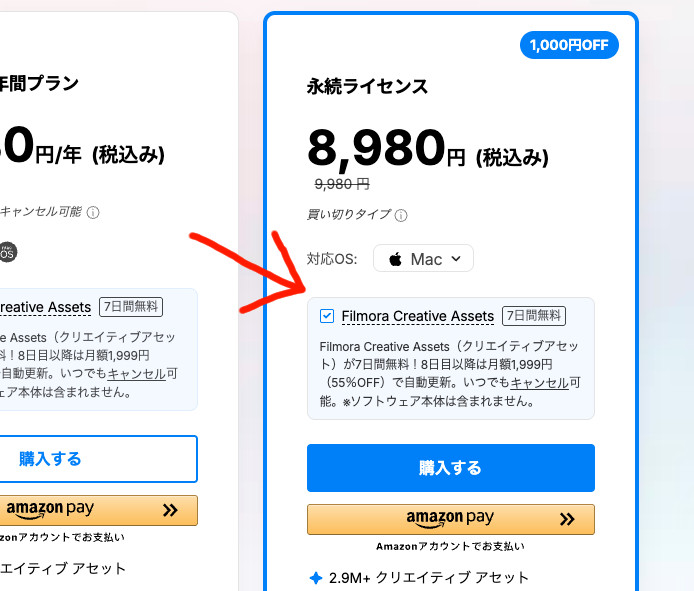
Looking closely at the bottom of the price, I see that the option to purchase a paid subscription is already checked.
And the text is small, so it's hard to notice.
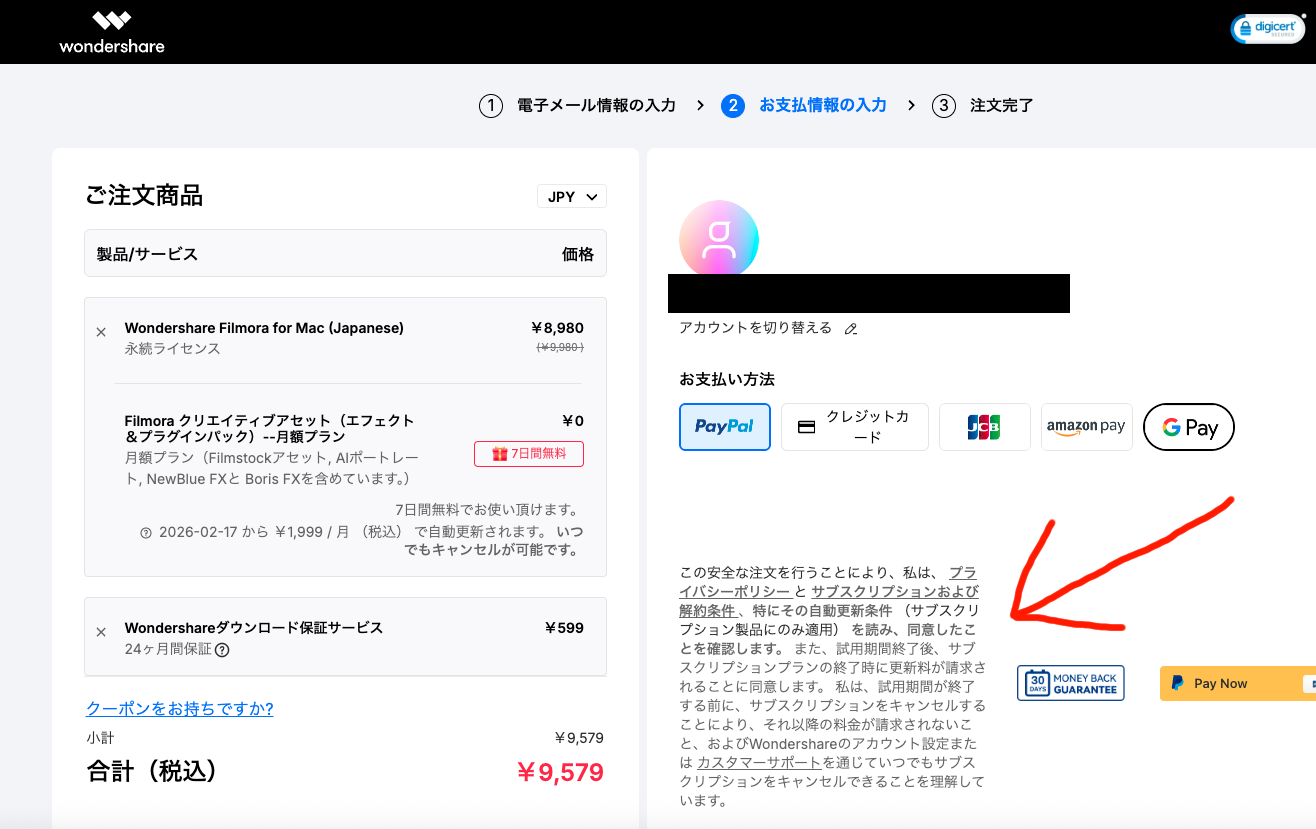
Purchase screen.
Looking closely, I see what appears to be a small agreement.
Excerpt below.
===================================
By placing this secure order, I confirm that I have read and agree to the Privacy Policy and Subscription and Cancellation Terms, especially their auto-renewal terms (applicable only to subscription products). I also agree that after the trial period, I will be charged a renewal fee at the end of my subscription plan. I understand that I can cancel my subscription before the end of the trial period to avoid further charges, and that I can cancel my subscription at any time through my Wondershare account settings or customer support.
==========================================
I see, so it seems I agreed to a paid subscription when I purchased it.
Subscription contracts are supposed to offer a safeguard against tricks like credit card or PayPal payment processing, but this can be circumvented by attaching them to one-time software purchases.
I'm not saying I'm entirely at fault for not carefully checking my shopping cart, but it's confusing to see the default bundled offer in such small print, and a quick look at Wondershare's reputation reveals multiple similar reports of fraud.
・Don't buy Wondershare Filmora. kaku
Some say it's a user mistake, but I think it's a system that easily leads to confusion.
This type of UI that catches users off guard is called a "dark pattern," and details are summarized in the following document published by the National Consumer Affairs Center of Japan.
National Consumer Affairs Center of Japan's "Kokumin Seikatsu" (National Lifestyle), March 2024 issue
[Special Feature] Dark Patterns that Deceive Consumers
▼Making the company's preferred option the default
This is the default subscription option on the purchase page.
▼Visually obscuring important information.
The subscriptions they include are often in small, hard-to-read font.
▼ Making task flow and interactions unnecessarily difficult with the intent of discouraging a certain action
▼ Making cancellation more difficult than signing up for the service
↑ This is what happens when you cancel a subscription.
There's a refund button in the purchase history on Wondershare's official website, so I submitted a request, but I've read reviews on Kakaku.com about people not receiving refunds, so the chances of getting your money back are slim.
The purchase screen has a consent form, albeit in small print, so it's a fine line that even the most careful and observant person would notice. It would be difficult to file a fraud case or pursue a civil lawsuit for a refund.
The losses far outweigh the gains.
But, after being caught off guard like this, I never want to use Filmora again, and I never want to have anything to do with Wondershare again.
I definitely can't recommend it to anyone.
I bought a Mac and don't have much money left, but I decided to buy some replacement video editing software.
Several people have received charges for things they didn't remember, and they have no intention of improving the subscription-related features or the confusing UI.
Knowing that this is the kind of company they are, I can't help but suspect they're also tampering with their software.
I'm going to uninstall Filmora from all my PCs, even though it will prevent me from accessing almost all of my past music video projects.
I haven't decided what software to switch to, but for now, Final Cut Pro seems like the best bet.
It's only available on Mac, but this experience taught me that any software can eventually become unusable for some reason, so I'll think about how to save my data so that I can easily restore it even if I switch to other video editing software.
There's an industry-standard format called PSD for image data, but it doesn't seem like there's anything like that for video editing software at the moment.
[Added 2/13]
In addition to the inquiry form, there was a "refund" button in the order history on the official website, so I applied for a refund using that option, and it was approved.
I complained in Japanese and got a reply in Chinese, so maybe it worked better to complain in Chinese from the start this time...?
NI, are you going to die...?
Native Instruments GmbH is in preliminary insolvency - CDM Create Digital Music
Native Instruments (NI), a leading name in the DTM world, distributor of KONTAKT, KOMPLETE, and other products, has filed for bankruptcy. This is a major event.
To be precise, it's preliminary bankruptcy proceedings, a situation similar to the Corporate Reorganization Act in Japan.
Non-DTMers might not understand, but if you were to compare it to the automotive industry, it would be as devastating as Toyota being blown away.
I think it's quite rare to find a DTMer who doesn't use at least one NI plug-in.
I personally own and use products from KONTAKT, Massive, FM8, and other companies.
NI's subsidiaries also include izotope, famous for AI mastering, and Brainworx, a leader in analog emulation plug-ins, and I use plug-ins developed by these manufacturers.
I suspect that many young DTMers, in particular, opt for OZONE for mastering.
About three years ago, NI acquired izotope and Brainworx, as well as Plugin Alliance, a platform for selling a variety of plug-ins, and launched a new brand called Soundwide.
The free distribution of their main products caused a frenzy on social media, and I still use some of the plug-ins distributed at the time.
I thought it was a power play that could only be pulled off because they were making a decent profit and had money to spare, and I never imagined that NI would go under.
I thought IK, which has been selling plug-ins at bargain prices recently, would go under first.
Now that the company that seemed the least likely to go under has gone under, no manufacturer's plug-ins are safe.
Perhaps it's no longer the time to complain about hating iLok.
No one knows what will happen to NI itself or its products.
There are various rumors flying around, such as Apple acquiring Native Instruments and making everything Mac-only, or Splice acquiring them and making everything a subscription service, but either way, it seems like it would be a good idea to reduce your reliance on NI, Izotope, and PA plug-ins.
The sound may change, but what matters in the end is the ability to create great songs, the ability to create masterpieces even in a different environment without relying on a specific manufacturer's sound modules or plug-ins, and the ability to adapt.
If NI doesn't work, just create it with plug-ins from other manufacturers.
And that's it!
[Added January 31, 2026]
Statement from Native Instruments CEO, Nick Williams
NI's CEO has released a statement.
It seems that sound modules and plug-ins will not become unusable immediately.
I have no intention of giving up the sound sources and plug-ins of NI and its subsidiaries, so I hope that the reconstruction goes well.
Hi, this is Enin.
Happy New Year!
I look forward to working with you again this year.
Now, a quick announcement: the "End of the World Compilation" hosted by Yuudachi-P, which has become a year-end tradition, was released yesterday at 11 PM.
It's called...

End of the World War Ensemble & World Ends
It's been released on Bandcamp and Booth.
This year, this gorgeous album by eight artists from a variety of genres is, once again, free...! *Tipping is also available on Bandcamp.
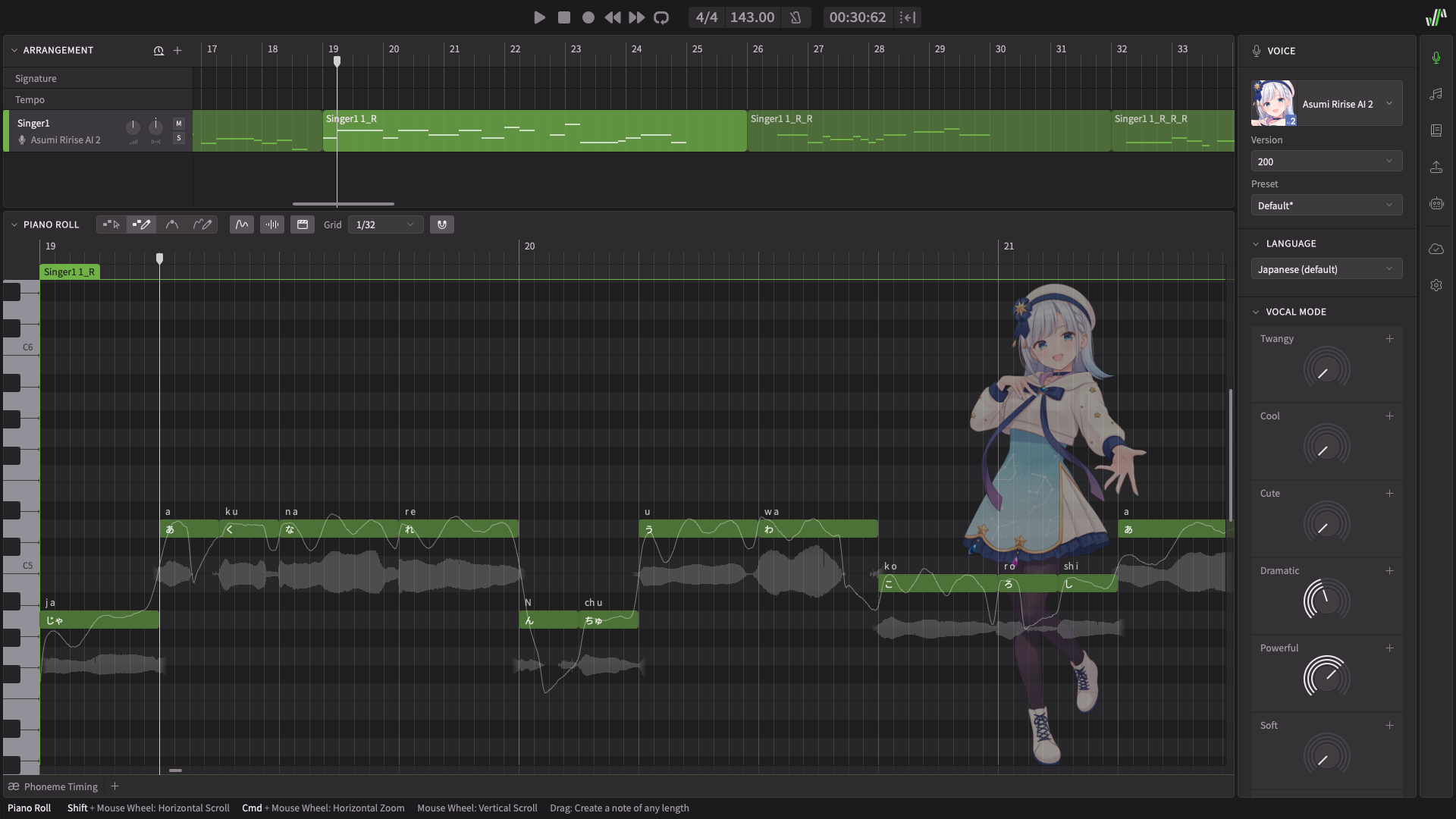
This time, I participated with the first track, "Utopia2 feat. Aisumi Ririse."
I encourage you to download the album and listen to it to find out what kind of songs it is, but this time it's an opera featuring a full orchestra.
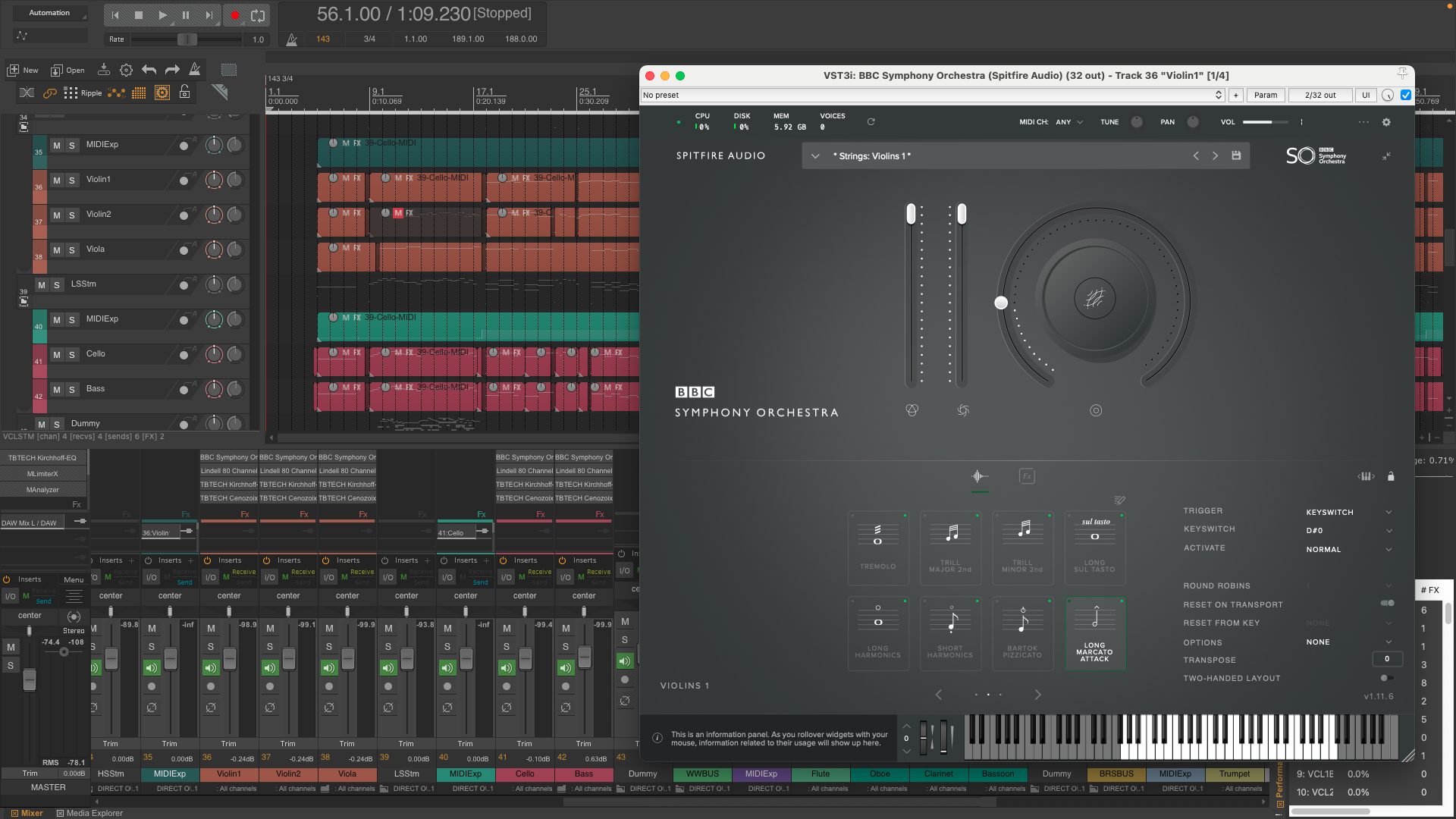
Please enjoy the melody woven together by the majestic BBC Symphony Orchestra, Ririsetan's beautiful voice, and the slightly strange lyrics.
The song after my own is the polar opposite, and then it continues with a song with a completely different image. However, perhaps because each song is of high quality and the track order is well thought out, I find myself strangely captivated.
Since the themes and restrictions are loose, everyone always releases songs of all different genres and musical styles, but I always think it's amazing how they put them all together on a compilation album.
Also, I've released a medley video of the works I released over the past year, so please check it out.
Around this time last year, I said I wanted to release 12 songs, and I managed to achieve that with the songs on the End of the World compilation.
Including videos, that's 10 songs (11 including self-covers), but I guess it would be counterproductive to focus too much on quantity and neglect quality, so I'm aiming to produce around 12 songs this year as well.
So, we look forward to your continued support in 2026.
And that's it!
PC memory prices are soaring due to AI companies buying up memory.
Eventually, the AI bubble will burst and prices will fall, but no one knows when that will happen.
Various theories are floating around, but the general consensus seems to be that PC (and smartphone) prices will remain high at least until the end of next year.
PCs are essential tools for my creative work, so I won't hesitate to buy one if I need one, even if the price goes up a few percent. Honestly, it's troubling when they're in short supply and difficult to obtain.
I can't stand a life without creative work for an extended period of time.
The computer I currently use primarily for creative work is a custom-built PC I built about five years ago, and it's been working flawlessly so far, but I leave it on all the time, so some of the components are about to reach the end of their lifespan.
I do have a laptop, but it's difficult to create solely on a laptop for long periods of time.

So I bought the latest M4 Mac Mini.
Well, my main PC has been freezing frequently when using heavy audio files lately, and Windows 11 updates have been plaguing me, so I've been missing my Mac, and I finally decided to go for it.
The price was a shocking 90,000 yen.
I didn't take out a loan.
As expected of Apple, they had ample inventory, so I was able to purchase it at the regular price without any memory issues.
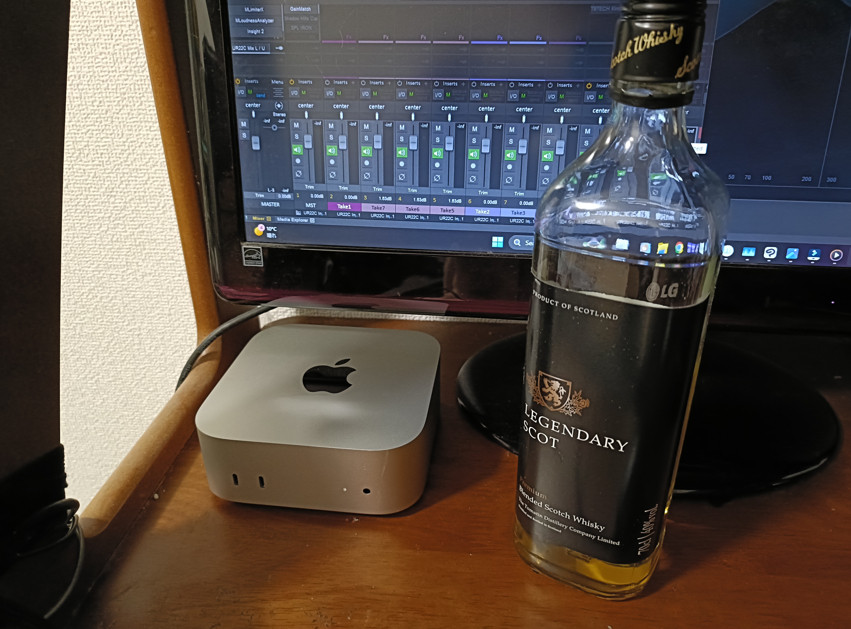
Compared to my previous Mac Mini (Late 2012), it's significantly narrower in width and depth, and slightly thicker.
The minimum configuration is a 256GB SSD and 16GB of memory.
Mac pricing is a bit unusual, with prices rising exponentially as you add more storage and memory.
The cheapest Mac Mini is like economy class on an airplane.
I feel like I'm being spoiled by a wealthy person who can afford a high-spec Mac.
I would ideally like to have a 2TB SSD and 32GB of memory, but this configuration cost a whopping 270,000 yen lol.
That's definitely way over my budget.
I've been making do with 16GB of RAM until now, and I can easily add an external SSD, so I think I'll be fine.
My desk will be cluttered with cables, but that's irrelevant; cost-effectiveness is everything.
Thanks to making the purchase early, I was able to get both the external SSD and HDD for a much cheaper price than I am now.
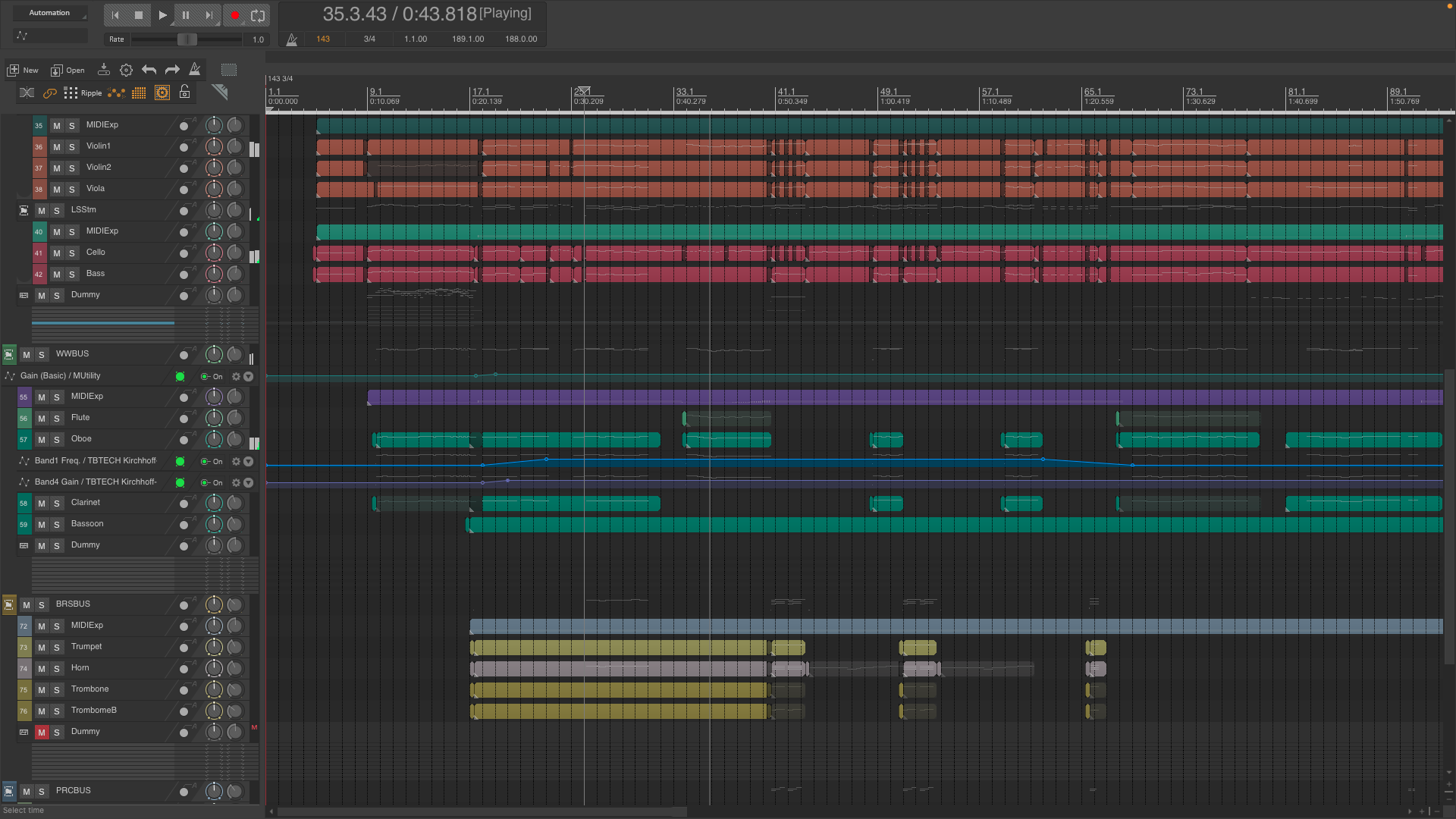
I haven't had much time to test the performance with DTM yet, but even when I loaded all the instruments from BBC Symphony Orchestra Core and played them, there was no skipping at all.
On my previous PC, I would sometimes experience skipping even when the buffer size was set to maximum, so this is a much smoother experience.
I think I'll be able to do DTM comfortably over the New Year holidays.
And that's it!